
This week on Everybody in the Pool
Reinvention and innovation are all well and good. But in a vacuum, nothing really gets done. The key to true, lasting, durable change is a spider at the center of the web, willing to do the hard work of diplomacy, coalition-building, policy framework development, and of course, encouraging innovation and reinvention where we need it. So for this episode, I went and found a spider, who’s spinning a web of change specifically for decarbonizing buildings.
As a refresher, buildings represent about a3 of US greenhouse, gas emissions, and 90% of those emissions come from space and water heating.
Panama Bartholomy founded the Building Decarbonization Coalition seven years ago after recognizing that utilities, manufacturers, installers, and nonprofits all agreed on what needed to happen with building decarbonization but had no forum to work together.

The coalition focuses on electrification through heat pumps, which are 2-4 times more efficient than gas appliances.
Panama also delivered some great news, which is that heat pumps have now outsold furnaces in the U.S. for four straight years, and last year, the the US surpassed China to become the world’s biggest market for heat pumps.
And electrifying buildings is not just about decarbonization. It is about one of our favorite buzz words lately, affordability. Gas infrastructure is becoming increasingly expensive—two-thirds of gas bills now pay for pipes rather than the commodity itself, and rates are rising faster than electricity and inflation. If we are electrifying, and we are, and we are also building new gas infrastructure at the same time, then we are effectively building double the infrastructure we need when there's nothing gas can do that electricity can't do better.
In terms of getting there, the BDC is focused on getting installers educated and on board, building friendly policy conversations, and working toward neighborhood-scale electrification, where utilities could electrify entire sections of the gas grid at once before retiring those pipelines, saving the $3-6 million per mile it costs to replace aging gas distribution pipes.
It's not always fast, it's not always sexy, but what Panama describes as "shuttle diplomacy" is absolutely the best possible road to lasting change.
Listen to the episode here or wherever you get your podcasts, and checked out BDC Wrapped 2025 for some good news on our progress toward a better future.
Recommended reading
You may have clocked Panama mentioning Donella Meadows and her thinking on systems change — I know this is a topic that’s on our minds for all kinds of reasons right now, from corrupt systems of government to extractive monopolies to climate action. So please do check out her essay on Places to Intervene in a System, which breaks down the 12 points of intervention, in increasing order of effectiveness.
Also, in case you missed it, on Jan. 27, with little fanfare and with zero mention of sustainability or circularity or anything like that, Apple quietly did a big climate action. The company released a new version of iOS for phones, iPads, and Apple Watches that includes patches for devices going all the way back to 2013. This, by the way, includes the iPhone 5, the literal best iPhone ever made. This is a subjective opinion, but only kind of.
You may remember that I recently discovered and recommended Back Market for buying refurbished electronics, and Apple’s new update means the circular economy for these gadgets is now official and much more functional and secure, thanks to this software support. Now that you can get your battery replaced and your software updated, there’s virtually zero reason to get a new phone every year or even every other year. It also gives Apple itself another avenue to keep making revenue on its own refurbished products, the way Patagonia does and REI is experimenting with. This is great news.
Buying advice
Speaking of shopping, or not shopping, I was heartened to see, recently, a fashion creator who built a Victorian-era look, using a vintage fur-lined coat. (I’d link to it, but it was on TikTok, which I unfortunately no longer have — also, we all know you can never find anything again once it’s passed you by in the feed.)
Someone in his comments chastised him and said he should be wearing faux fur. And bless him, he responded and said, “absolutely not. Faux fur is plastic, and vintage fur is re-use.”
Now, I talked about this way back in Episode 45, and titled my newsletter “Vegan leather is a lie.” But it’s still taking a really long time to socialize the fact that “vegan” leather and faux fur are, like just about every other synthetic textile, made from plastic — which is, of course, fossil-fuel derived and toxic.
It’s taking so long, in fact, that a friend recently posted this AI summary in a group chat suggesting what we all might wear to a Depeche Mode cover band party:
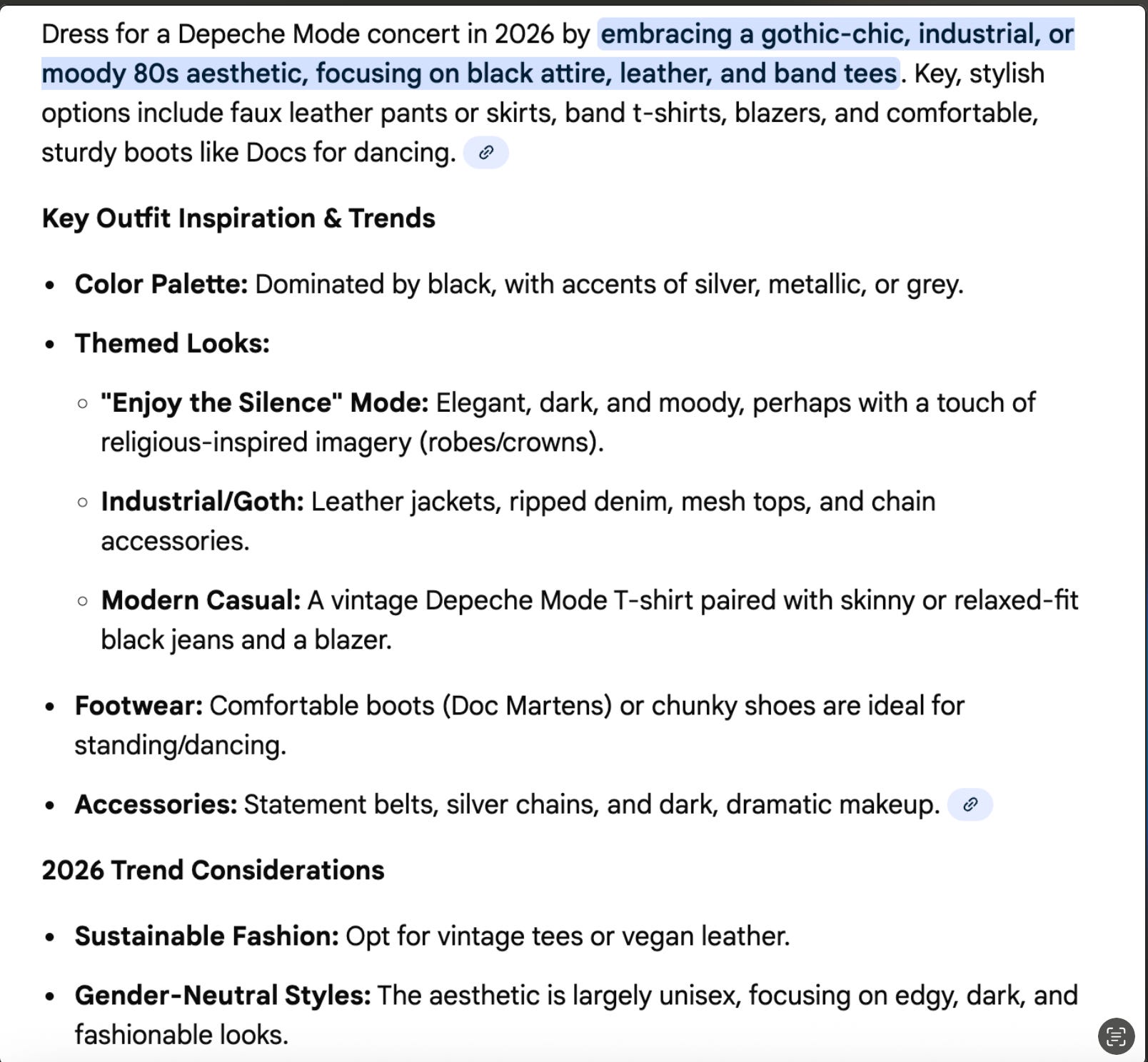
While I’m delighted to see that AI thinks sustainable fashion is a 2026 trend consideration (win!), suggesting vegan leather is not it. This caused me to have to be That Person in the chat, and tell everyone that vintage fur or leather are actually vastly preferable — assuming you’re willing to wear either, for ethical reasons. If you’re not, that’s totally fine — both systems are massive sources of animal harm. But I am begging you not to buy new faux fur or faux leather as a replacement if you think you’re getting the look without the harm.
Ok, happy thrifting!