

This week on Everybody in the Pool
So, you know. Data centers. Those are a thing.
Even as many cities and states offer tax breaks and loosened restrictions on new infrastructure, citizens and politicians are pushing back on new projects over land use, water use, noise, and energy usage. Just as many states are contemplating or passing bans and moratoriums, and data center project cancellations quadrupled between 2024 and 2025, according to Construction Dive.
But hey, what about the data centers we already have? Who’s working on the energy, water, and environmental impacts of those data centers?
One answer is in this week’s podcast episode. I spoke with Jasper de Vries, co-founder and CEO of Lucend, a company using machine learning plus massive amounts of sensor data to help data centers operate more efficiently. Jasper told me working with data centers is kind of a dream, because of, uh, all the data. A typical facility is absolutely festooned with sensors, gathering everything from heat and power draw, humidity, water flow pressures, chiller performance, power quality, UPS and generator reliability, filter pressure drops and fan speeds for airflow purposes, leak detection, and even smoke and air-quality monitoring for early fire detection.
But for the most part, all of this is contained in what Jasper calls a “black box” of operations, and it’s not being used to optimize efficiency — it’s mostly about uptime and safety. By opening the box and analyzing the data with efficiency in mind, Jasper says Lucend typically finds big savings hiding in plain sight — on the order of 25% energy savings on average and 30% water savings — without needing any retrofit or rebuild.
But implementing changes within a facility that depends on 99.999% uptime is super complicated and operators are intensely risk-averse. A seemingly tiny operational tweak can trigger weeks of risk-management process, he said.
Lucend shows operators the entire trail from symptom to diagnostics to recommendation so teams can validate the logic, de-risk the change, and confirm the impact afterward. (You could imagine all that paperwork coming in handy as communities demand accountability, and regulators jump in, as well.)
Down the road, Jasper said, he hopes this technology can enable energy flexibility, the thread we’ve been pulling on all season. He sketched a future where data centers don’t only consume power. As they add on-site renewables and storage, they could become flexible resources that can dial demand up or down, or even support the grid, at peak times. If cities are going to live with more data centers (admittedly still an open question, it seems), the best possible bargain is: fewer wasted megawatt-hours, less water use, and a path for these facilities to improve energy infrastructure, not strain it.
Listen to the episode here or wherever you get your podcasts!
Better data centers through design
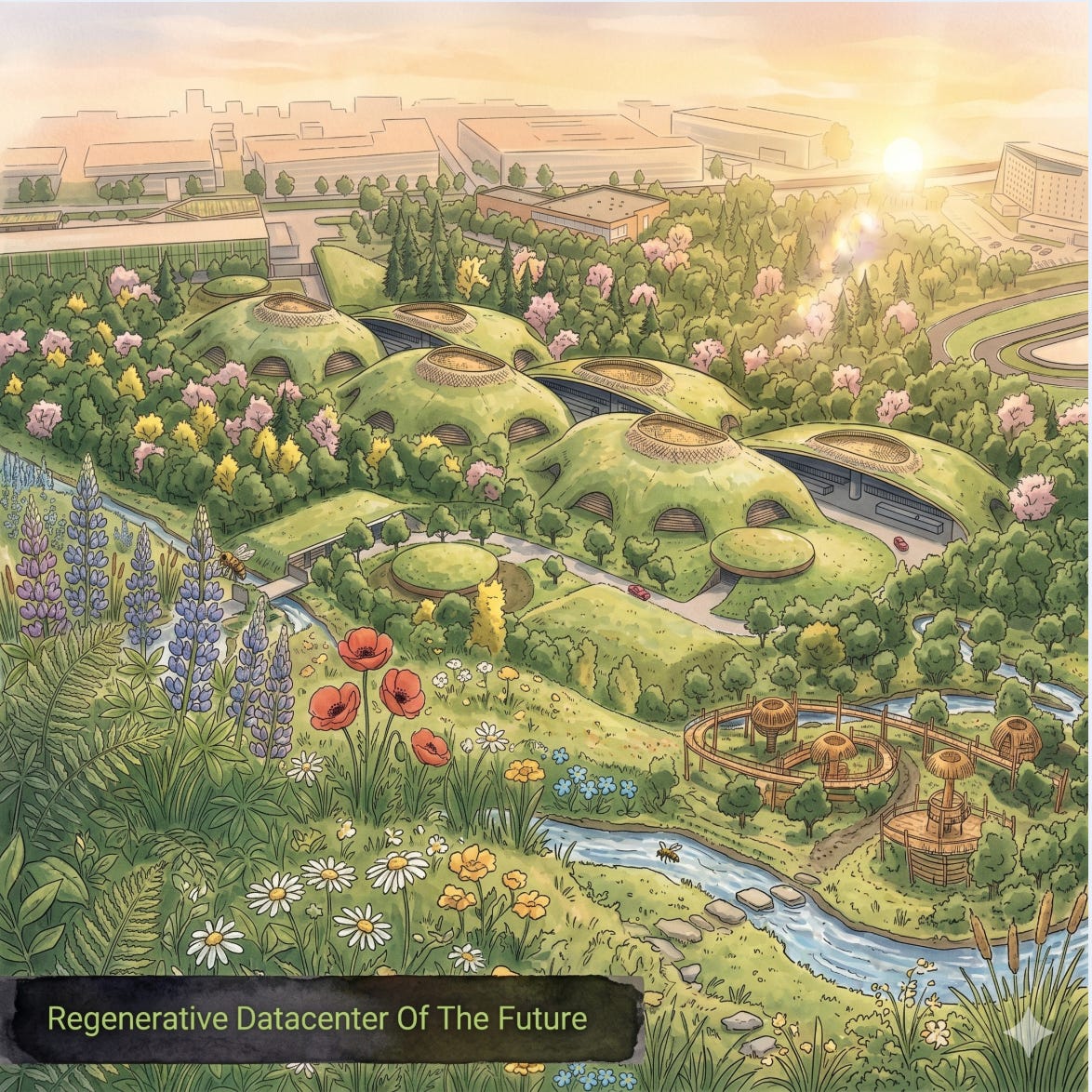
At the beginning of last year, I did a series called Feeding the Matrix, anticipating many of the energy issues data centers faced and would be facing. One of my favorite interviews was with JoAnn Garbin, who was formerly the head of a regenerative data center project at Microsoft. The mission was to reimagine data centers that would be maximally energy and water efficient, designed to integrate smoothly into landscapes, use low-carbon building materials and eliminate waste. Microsoft … went a different route. Everyone did, actually.
So this month (April, 2026), JoAnn went ahead and published all of it. To quote from her post on how it can be done:
Picture a 2 to 20-megawatt cluster sited at the edge of a mid-sized city or a county seat. Sitting on 1 to 20 acres. Not a campus. A modular cluster. Flatbed-deliverable, prefabricated, deployable in 90 to 120 days instead of five to eight years of active construction.
Inside: AI-class compute with warm-water direct liquid cooling at 45°C — the threshold that eliminates the chiller entirely and makes the waste heat usable.
Outside: heat exchangers routing that waste heat into a district heating system, a commercial greenhouse or aquaculture facility, pools, laundry, airports, microbreweries.
Underneath: a grid-interactive battery stack and power architecture designed from day one as an interruptible load, participating in demand response, shaving utility peaks, returning flexibility to the grid.
Around town or across the state: many small clusters like this one […]
Before any of it rolls out of the factory: a community partnership with real economic value — local fiber and green energy, workforce training, municipal revenue share, biodiversity net gain, a heat offtake contract — negotiated before the first permitting conversation, not offered defensively after opposition forms.
All the technology exists, JoAnn writes — even the vendors, the deployment dockets, the timelines, all of it. It’s all here if you really want to geek out. And have a peek at one of the concept drawings and let yourself imagine a better world, for a second, won’t you?
SF Climate Week Wrap-Up
I attended a tiny fraction of the many events that happened at San Francisco Climate Week this year, which has ballooned in just a few short years into a truly exciting, vibrant, busy gathering — congratulations to everyone who put on an event or sponsored the whole thing this year. I spoke at a delightful event that was right up my philosophical alley, called Life, Upgraded, hosted by Xooglers in Climate. They curated and spotlighted cool, real-life solutions like seaweed packaging from Sway (featured on episode 44), electric heaters from Focal, regenerative bedding from Knotted Weaves, recycled textiles from Rhea's Factory, and plastic-free packaging from Shellworks, sustainable 3D-printed boards from Swellcycle.
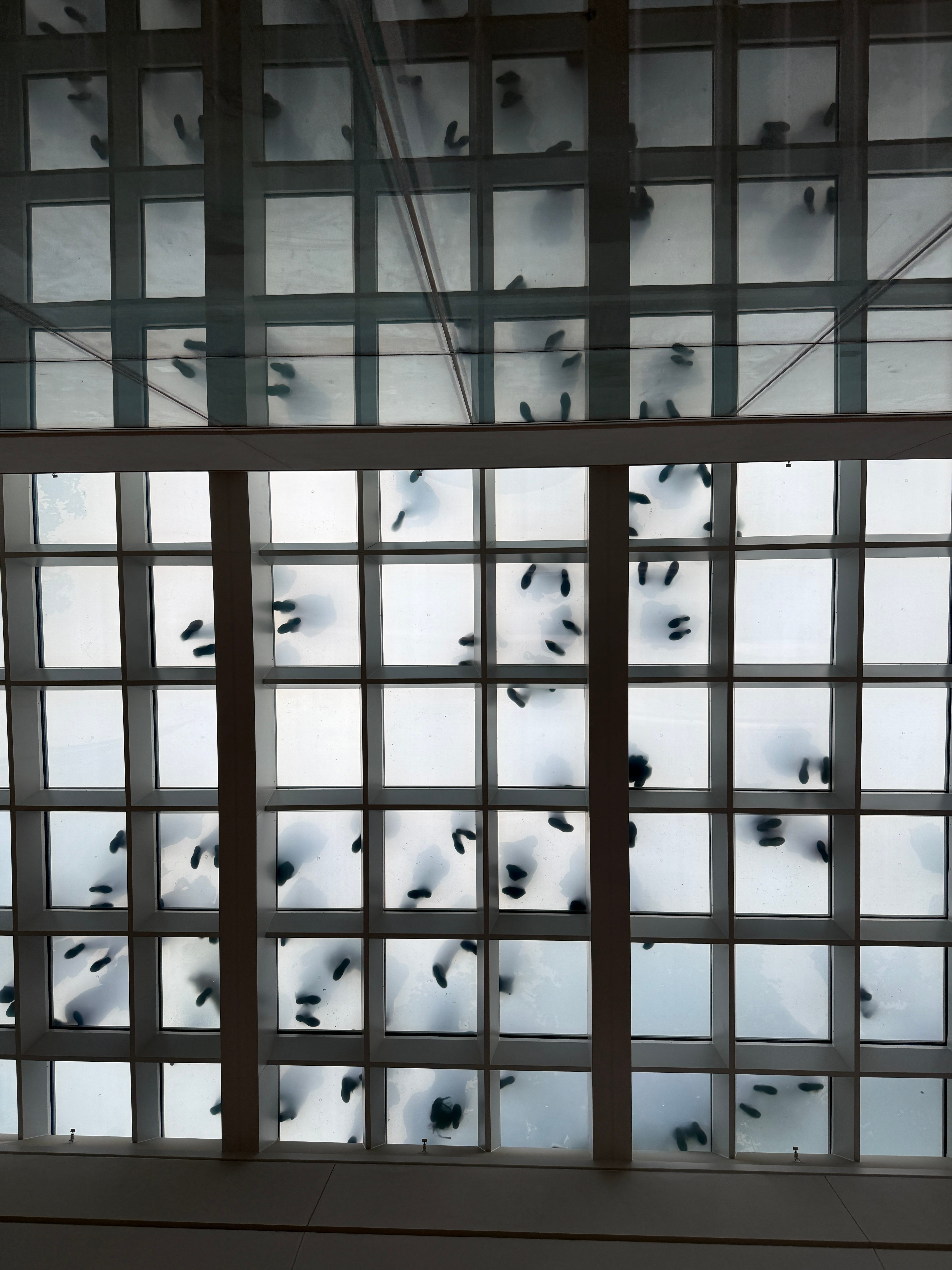
I also attended the Female Founders and Funders event, where I took possibly the coolest photo I’ve ever taken, below Salesforce Park:
And finally, I went to my absolute dream event these days, a panel on whether VPPs can solve our capacity crunch, featuring Copper (episode 122), Lunar Energy (who’ll be on the show soon!), Prelude Ventures, and Sunrun. Standing room only, folks. I’m not the only VPP nerd in town — at least during SF Climate Week. A couple photos to wrap this one up. See you next week!


Also on the outside, big honking DC's should be covered in solar panels. Make them make some of their own power, sort of.