
This week on Everybody in the Pool
First, a correction and an apology! In the original release of this episode, I said I was speaking with Josh Garrett of Redwood Earth Communications, when in fact it’s Redwood Climate Communications. The audio has now been updated!
Hey, so, this week on the show, I talked with Josh Garrett of Redwood Climate Communications about a topic I’ve weirdly neglected (considering it’s what I try to do every single day): climate storytelling and communication.
Josh and I dug into the specific difficulty around this work — the fact that “climate” has become a political tripwire again. His take (and mine, as it happens) is basically: don’t go silent, but do get ruthlessly context-aware.
For some audiences, especially anyone depending on federal funding, that can be as practical (and bleak) as scrubbing certain words from public-facing comms and leading with “co-benefits” instead: pollution and public health, affordability, efficiency, reliability, and the “this is just better tech” argument. If people won’t listen to “greenhouse gases,” they will often respond to “pollution.”
We also talked about the messaging mismatch: fossil fuel interests have basically unlimited money and decades of coordinated, consistent propaganda muscle—while climate/clean energy is comparatively scattered and, ahem, prone to over-explaining (don’t @ me, you know this is true, my science-minded friends). Josh’s prescription: get pithy, repeat a few sticky truths (his favorite is “clean energy is cheap energy”), and coordinate like you mean it.
And on the “what can people actually do?” side, he argues for talking about climate out loud (the anxiety is there; the conversation often isn’t) and showing up locally—zoning meetings, town halls, the unglamorous places where solar and wind projects get approved or killed—because the loudest voices in the room shouldn’t automatically be the ones saying “no.”
“The stakes are high, but the power is ours and every little bit of incremental progress we make makes a better outcome in the near and distant future.” - Josh Garrett
Listen to the episode here or wherever you get your podcasts!
Recommended reading
Here’s a good piece that happens to quote Josh, on Bad Bunny’s use of broken power lines during his Super Bowl performance, and how effective it can be to simply tie real-world experience to climate events. Unfortunately, this is likely to become more effective as more and more people experience climate shocks.
A very problematic note from the article linked above:
The public is also hearing less about climate change. The fall 2025 Climate Change in the American Mind survey found that only 17 percent of Americans say they hear about global warming in the media “at least once a week,” the lowest percentage since the question was added to the twice-yearly effort in 2015. Yet the same study found that 64 percent of Americans are at least “somewhat worried” about global warming.
More than one climate communicator I’ve talked with has told me the that a really impactful thing you can do to combat climate change is simply to talk about it with friends, family, and at work. Social permission is very, very real. (And yes, don’t get me wrong, the mainstream media are deeply failing us on this issue, but that’s … a whole other topic.)
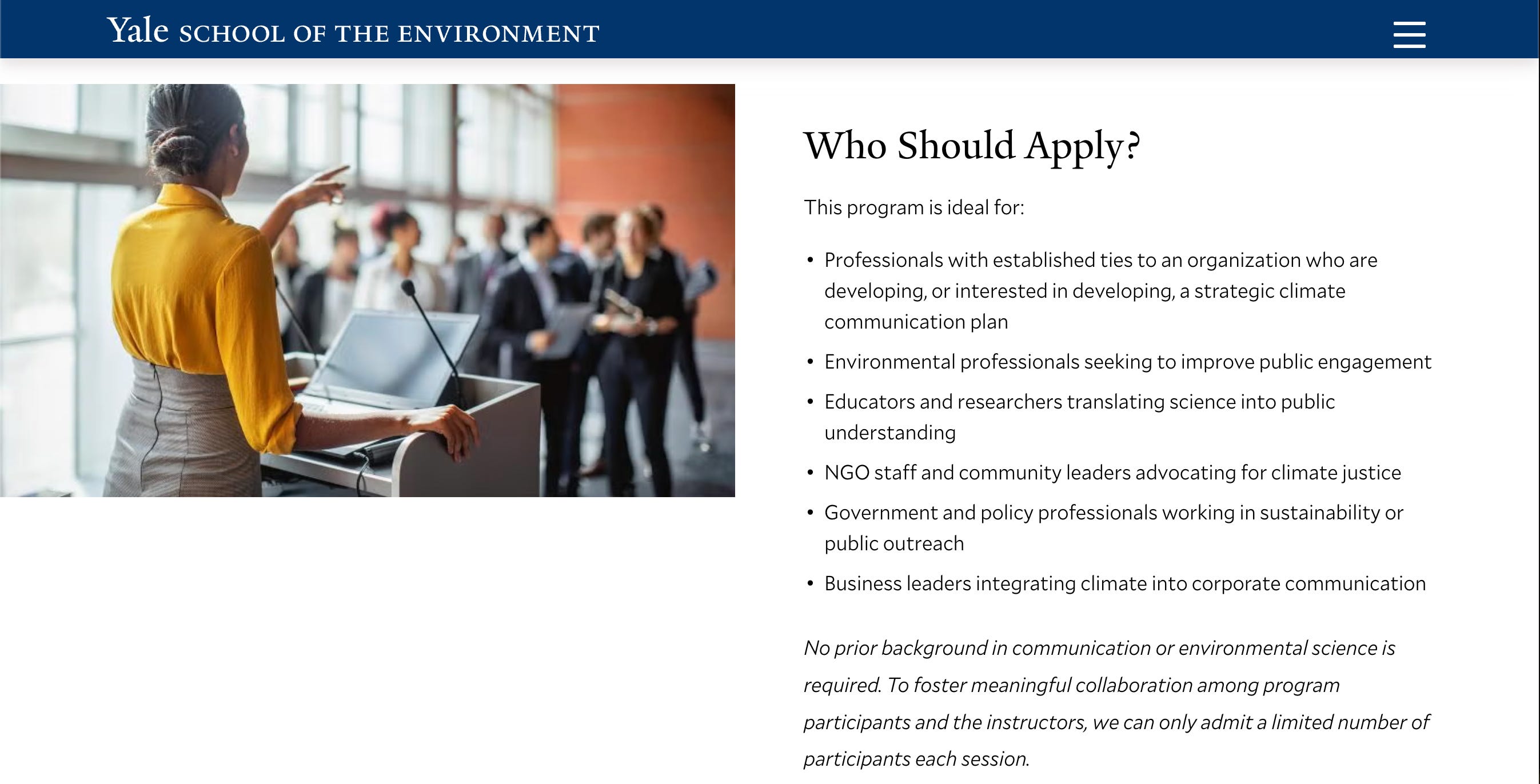
Also, if you’re really into this topic, Yale launched a new 14-week certificate program in strategic climate communication. The application window is closed for this year, but keep an eye on it for the future if you’re in one of the fields below.
From the Discord:
Some things that have jumped out and been interesting in our Everybody in the Pool Discord server, which is up to almost 100 members (join at the link in this here sentence!):
A writeup on the Geely Galaxy G9 plug-in hybrid, a Chinese SUV that, with its gas-electric motor, gets an estimated 800-mile range, about which Edmunds writes: “In track and on-road testing, this three-row SUV exceeded almost all of our expectations. Chinese cars are ready for prime time in America.”
This cool video on what to do and what not to do as you build a net-zero home
This amazing post (Bluesky) on how 1,200 years of Japanese records of cherry blossom blooms have accidentally created a treasure trove of climate data (this year’s bloom is the earliest on record)
A discussion on best used EVs to buy in a time of skyrocketing gas prices (or anytime, really)
Hope to see you in there!