

This week on Everybody in the Pool
We’re in the midst of a global obsession with protein—whether because of perimenopause and menopause, the popularity of GLP-1s, the longevity crowd, or just some impressive meat industry lobbying and influencing. At this point I feel like the word “protein” should come with a trigger warning.
Either way, this obsession now extends to the recently released new American food pyramid, which has red meat, whole milk, and cheese firmly at the top of the pile — making it an unqualified environmental disaster (not to mention firmly at odds with the American Cancer Society and the American Heart Association).
One of my favorite climate resources is the Speed and Scale Tracker, which lists Fixing Food as the third most important objective on a list of 10 that we need in order to get to net zero. The global food and agriculture system is responsible for 7 gigatons of annual carbon emissions. Of that, 3 gigatons alone is attributed to cows.
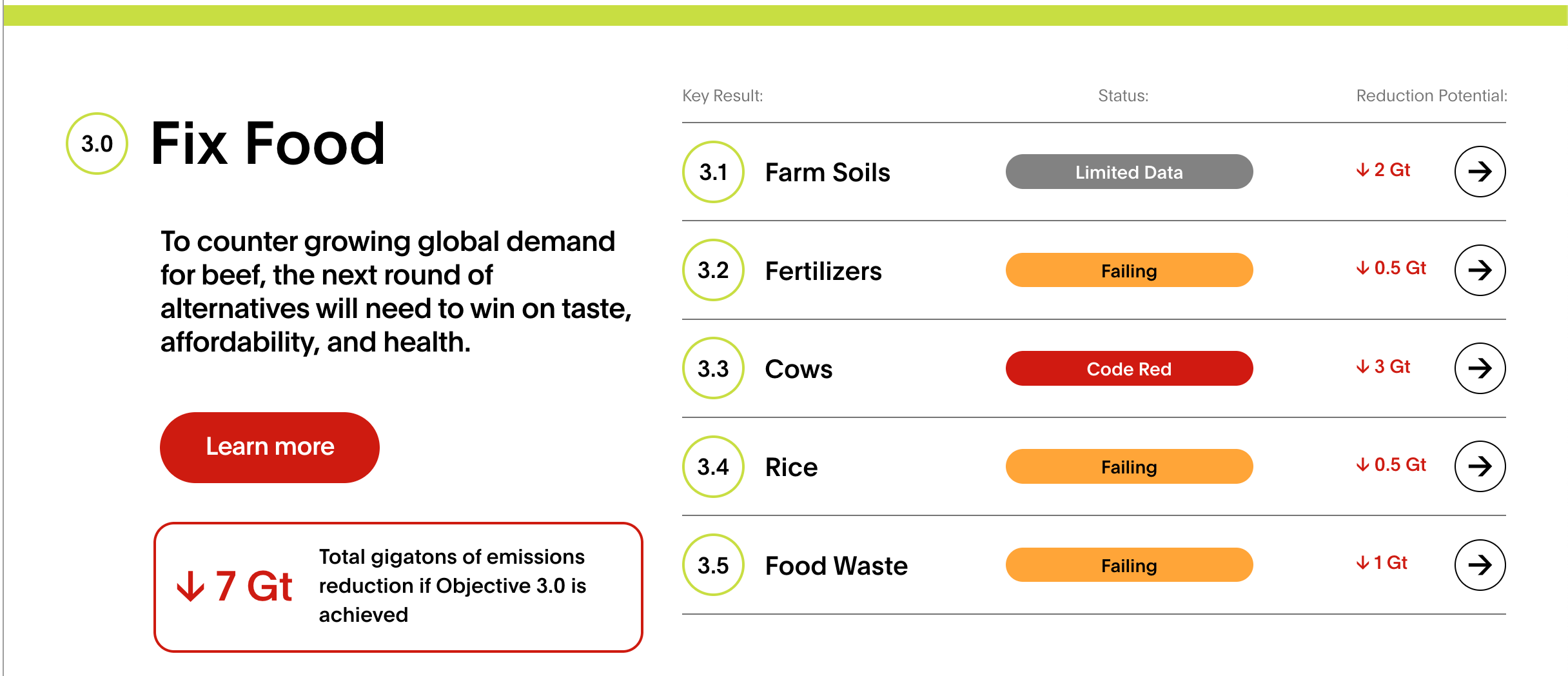
Cutting out red meat and minimizing or eliminating dairy are massively impactful personal climate actions. Even a Mediterranean diet can reduce your carbon footprint by half or more, in addition to being pretty damn empirically better for you than the new American food pyramid.
And that, in a roundabout ranty way, gets us to this week’s startup, Leaft Foods.
Their tech extracts pure, high quality protein directly from the source—green leaves, specifically alfalfa—and in the process, potentially creating co-benefits that could improve the entire food system. Leaft isolates RuBisCO, the most abundant protein on the planet, from alfalfa, and have developed a nutritional powerhouse that outperforms eggs, whey, and beef in amino acid profile. Their first product is a nutritional supplement called LeafBlade, which crams 18 grams of protein and 58% of daily iron intake into a tiny 100ml pouch.
On that note, I tried it. It’s … weird. But they warned me it might be a little weird, so that’s ok. And it is, as I predicted, good in a smoothie!
Listen to the episode here or wherever you get your podcasts!
Behind the scenes
So much bonus content this week, but I didn’t want to leave this bit out even though it didn’t make it into the edited interview. As I think about reinvention, one of the things I often wonder is, why didn’t this happen sooner? Was there no economic incentive, did no one want to before, was the tech not available? Ross gave me a fascinating answer about science, failure, and how to go back to the drawing board to come up with something new.
Here’s the audio, and the transcript is below.
Molly Wood: Why are you the first? I feel like this is always the question. Like, why are you the first? Why didn’t anybody do, know, it’s clear Rubisco is known. We know it comes from green leaves, it sounds like, you know, why, why is this the problem that had not been tackled, do you think?
Ross Milne: It’s probably a combination of things. You’re right, it has been studied for a really long time, particularly within scientific communities. There’s a plethora of literature out there. You can Google it. You can see so many university literature papers saying this is the utopia protein. All of that knowledge about how it could be the solution, it sits there. I think...
There’s a couple of things. technology is more readily available now than what it was 20, 30 years ago from a processing point of view. We started this company at the, when that, let’s call it a bubble, when that bubble.
of investment or when that large amount of investment was getting pushed into oat proteins. So that that point in time, it really enabled us to raise the kind of capital required to give this a real go. But it’s also worth mentioning that there’s been just about every large multinational food company in the world has at some stage explored Robisco. Either had their own internal team or funded an R &D project into it. There’s been some serious money deployed into this.
I think we build on top of the shoulders of giants in the sense that we read the first year we read every single piece of literature we contacted every team that would talk to us who had worked on Robisco and asked them you know as much as they would share with us we tried to capture. From that
we developed what we thought was a suitable process and the process that would work. We scaled that up to pilot scale. It did not work. We were not able to achieve what we needed to from a yield point of view, which would ultimately lead to an economic viability point of view. And so that meant at that point, we had to actually go all the way back to first principles. It forced us, that failure, that early failure forced us to completely rewrite the book on Robisco. And there was a lot of stuff in that existing knowledge and literature that turned out to not be true in reality. As we scaled things, they just did not hold true. There was sort of quite critical assumptions in...
built all the way back to like the early 60s that people had kind of taken as an assumption and then built upon and then it turned into a truth. And yeah, we had to go right back to the beginning. And it probably just located all the way down here in New Zealand is sometimes an advantage.
Molly Wood: Wow.
Ross Milne: We’re not influenced by other research. We’re geographically a long way away. It forces us to come up with our own hypotheses and own approach. And then we probably got lucky a few times. There was a few things that surprised us. This shouldn’t work, but it does work. That’s odd. And so you make your own luck in life, but there’s definitely a few things that surprised us.
Molly Wood: Right, let’s not underestimate your turbo genius, know. That’s cool though. So you’re like the fusion of protein. Like, always theoretically possible, but needed the right approach to crack it.
Ross Milne: Yeah, definitely needed the right approach and the right team and the right environment with the right funding, the right timing. There’s been great teams that have worked on this before. Maybe the timing was just not right. They either didn’t have the capital to keep going or whatever the challenge was at that point.
Further reading
It’s possible that some of the protein obsession may be starting to lift (after all, the pendulum is real. A couple examples this week:
Thanks but we already eat plenty of meat, says MSNOW
Per the BBC, “fibremaxxing” is the new hotness
This all reminds me of a conversation I had way back in episode 16 about veganism, where Jessica Resler made the point that in fact, yes, Americans already get plenty of protein and almost no one gets enough fiber.
This newsletter feels long enough without more buying advice, but next week, I’ll have a review of the shortest experiment ever in trying a convenient meal service that just left me with a giant pile of plastic and waste. Pardon me while I go make myself a plant-forward lunch. See you next week!