
This week on Everybody in the Pool
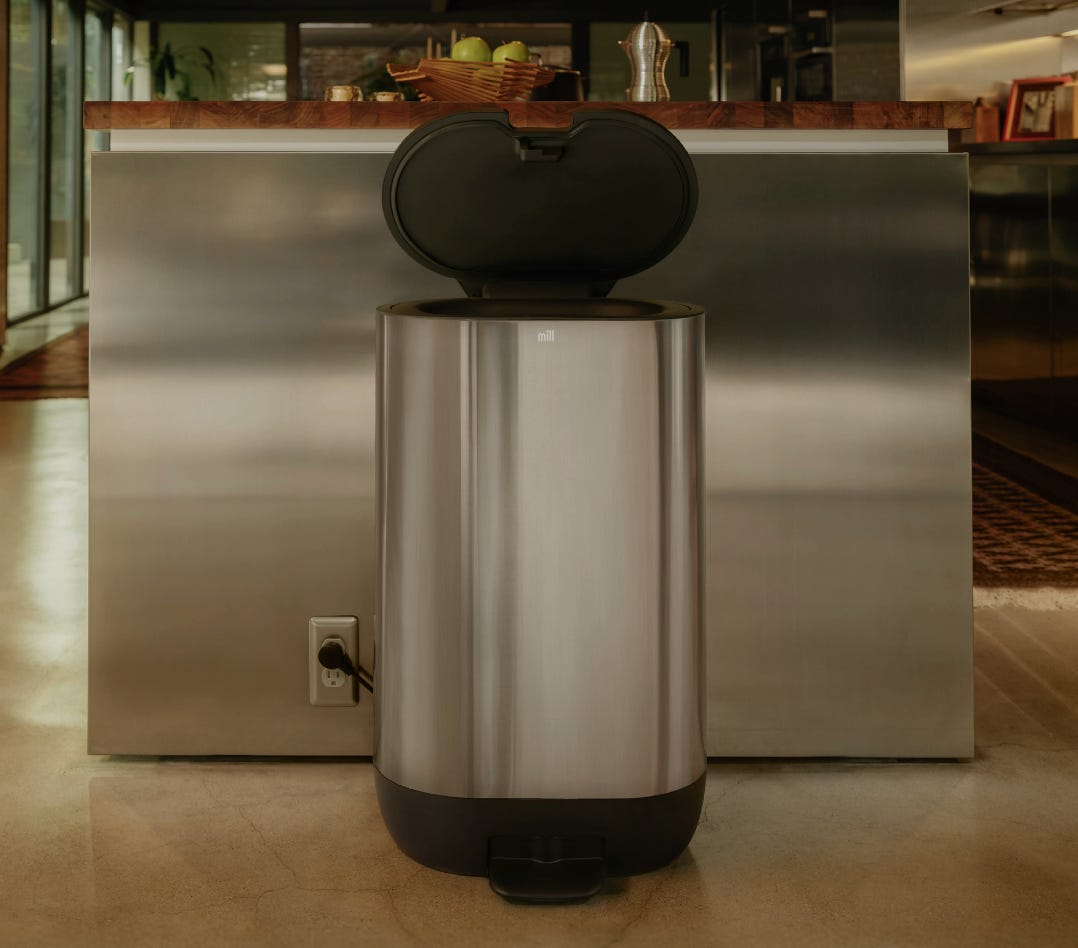
Mill is back on the show! You may recall that Mill is the maker of a home composting appliance (they call it a “food recycler”) that takes your food scraps, heats and dries them overnight, and turns them into dry, slightly sweet smelling grounds that can be used in the garden, tossed in your green bin, or mailed back to Mill to feed chickens.
And now, the company is going commercial. Co-founder and President Harry Tannenbaum joined the show to tell me that Mill is rolling out a larger, modular version of its dehydrating food-waste system designed for working kitchens. It’ll be roughly the size of a commercial dishwasher and built to handle hundreds of pounds a day. The headline partnership is Whole Foods: Mill plans to deploy the equipment across all Whole Foods locations in 2027, with Amazon involved (and invested) via the Climate Pledge Fund.
And while a Mill at home reduces emissions and wasted food, feeds those chickens, and over time can even change your buying habits as you start to realize how much you waste (damn you, arugula), a Mill at the commercial level does all those things and also saves money.
Harry reminded me that “about $400 billion dollars worth of food thrown away every year in the us, which is like one and a half percent of GDP.” If you’re a restaurant or a working kitchen at Whole Foods, you don’t want to buy more than you need, and you want to use what you buy. The commercial Mill machines will have cameras inside to characterize what’s being thrown away. That will help make waste more preventable.
Oh and don’t worry, the chickens are still, as Harry said, “the star of the show.” For Whole Foods, the dehydrated output is expected to go into its own chicken-and-egg supply chain as feed, creating a tighter loop from leftover food to chicken feed to eggs.
By the way, Harry told me he has, indeed, gotten to enjoy Mill-fed eggs. Let me know in the comments or email whether you think Mill should make a sticker for future egg partnerships. I mean, I’d buy Mill-fed eggs, wouldn’t you?
Book recommendation
I love it when my guests recommend books. Harry’s reference was Junkyard Planet (yes, I linked to a used bookstore, circularity, hello). Here’s a quote from the audio that didn’t make it into the episode, but he mentioned it in the context of all the ways a company like Mill could, in the future, try to capture value from wasted … well. All kinds of things! Here’s what he said:
HT: When we were first starting [Mill], I just like tried … there are like 28 books on waste so okay, we’re just gonna read em all. Junkyard Planet’s a great book. It’s about the scrap metal industry and there’s a chapter in Junkyard Planet that’s about recycling Christmas tree lights. I don’t think about Christmas tree lights as recyclable but like sure enough there’s a a town in China. They’re really good at recycling Christmas tree lights.
If you you know you get the lights you pop the bulbs off, test the bulbs, strip the wires, melt on the copper or reline the copper, put the bulbs back in. You get tangles of old, half-broken Christmas tree lights that go in one side and then you get brand new Christmas tree lights that go out the other side.
But you need to get the Christmas tree lights to that town, right, which is highly inefficient. It’s hard right now
… So you know there’s all sorts of kinds of things that don’t feel like you could get the value out of them. But if you can get them to the right place — if you can get to the mouth of a chicken, you know, it’s value.
Listen to the episode here or wherever you get your podcasts!
Happy Heat Pump Week!
You may remember when Panama Bartholemy of the Building Decarbonization Coalition was on the show recently, talking about how heat pumps are everywhere and only expanding? Well, the BDC has declared this week — April 11-18, to be precise — to be Heat Pump Week. It’s a statewide celebration in California, across multiple cities, with in-person and virtual events, videos, education campaigns, and actually they’ve even rounded up and are offering special rebates and incentives all month for people who are shopping for a heat pump, so definitely check that out.
And that makes this the perfect week to announce that I, myself, am getting a heat pump! I’ve actually partnered with Quilt, who was on the show back in February. They’ll be providing me with the Quilt system, and I’ll be paying for the installation, and I’ll be doing a six-month review that covers the install, usage, any changes in bills, any pros or cons, etc. We’ve agreed that this editorial process will be entirely independent, and I think my longtime followers know I’ve got a minimal filter, so don’t worry — no compromises.
Here’s where things stand so far, and I’ll be updating with writing and video as installation and usage progress. I’ll also be as transparent about cost.
This will be a ductless system, meaning each room will have its own wall unit for heating and cooling. You may remember from the interview that Quilt’s whole deal is making these indoor units as attractive as possible, since Americans aren’t used to and can be resistant to the mini-split look inside the house. But the benefit of a smart ductless system is that you can control each room individually, meaning, for example, my basement might not need any heat or cooling at all if I’m not in there. Maximally efficient, energy-wise.
Plus, this is huge for me, because I currently don’t have air conditioning at all! That’s not uncommon in the Bay Area, but I live up on a hill with, as I like to joke, “nothing between me and God,” and however hot it is outside, it’s the same or hotter inside. Witness my feelings on the topic when we had an early-season heat wave in March.
So yeah, this is awesome. Ok, let’s talk cost.
The money
I’m working with Air Synergy, which is a local installer who carries the Quilt system. I got a couple bids and while they weren’t the cheapest, they did a comprehensive site visit and checked out every single part of the house, electrical panel, and spec’d out all the locations for the indoor units in a way that made their bid extra believable.
The cost for installation of two outdoor condenser units and four indoor wall units is just under $20,000, and that could rise a bit with permitting. One minor downside of the Quilt system is that its outdoor units only support three “zones” — aka, three indoor units. I want to heat and cool four zones (upstairs main area, primary bedroom, and two downstairs bedrooms), so I have to get two outdoor condensers.
Heat pumps from other manufacturers, like Mitsubishi or Daikin, can support more indoor units — up to eight, in Daikin’s case. Quilt says in its FAQ that the reason for this is, basically, not to overbuild. It says its smaller units are more compact, quieter, and energy-efficient, and make it easier to control each room individually, for maximum energy efficiency. I guess if I have two outdoor units and one only has one indoor unit attached, I do have some flexibility to add more wall units if need be (for example, I’m skipping my downstairs family room, which I guess I could theoretically want to heat and cool at some point after all.
I’m financing the installation through the state of California’s GoGreen program, which helps finance residential and business upgrades with (relatively) low-interest loans for decarbonization and electrification projects. (If you’ve been wanting to get solar and a battery but not pay for a solar lease that goes up in interest every year, this is a great option, as but one example.) So that’s great, and I got a two-year loan at 3.99%, but it definitely has slowed down the process significantly. It’s taken about a month to get all the approval, and then get the contractor to upload the project to GoGreen to get verified, but I think we’re closing in on scheduling, so I thought it was safe to go ahead and announce it now.
Please email me if you have any questions as this goes along! I’ll keep you posted, and friends, I am super excited. I’ve been meaning to get back to my roots as a proper tech reviewer, and what better way to start than here?