

This week on Everybody in the Pool
I was at a lunch several months ago when someone casually mentioned that she’d ordered some plug-in solar panels from Bright Saver, which is a nonprofit entity that’s making inexpensive plug-in solar panels to Americans, and has also found itself in the position of advocating for policy changes that actually allow Americans to plug in their own solar.
As you’ll hear in the episode this week, plug-in or balcony solar, depending on where you’re hearing about it, is exactly what it sounds like. You get a smaller version of the same exact panels that are on rooftops, plug them in to standard outlets, and generate electricity when the sun is shining that supplements and replaces whatever other power is coming into your home. Bright Saver estimates that, depending where you are, you can save $35-$55 a month (those are probably California numbers, but it can still be a couple hundred dollars a year in most places), meaning the panels pay themselves back in just a couple of years. And as the market for these panels grows, they’ll only get cheaper.
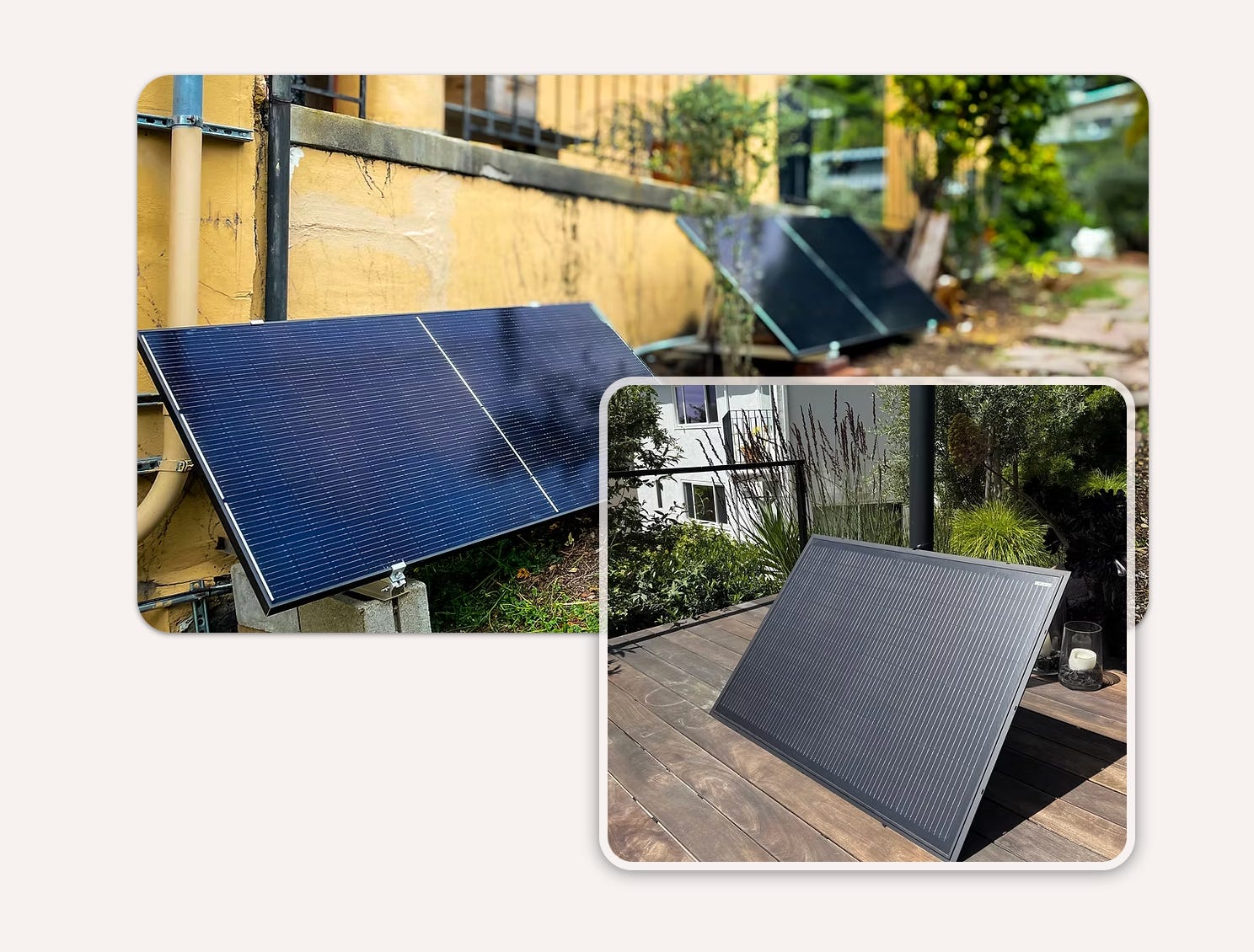
These panels reduce the amount of electricity you draw from the grid, and they don’t actually have to interact with the grid at all — some are designed to be “zero export,” meaning they generate electricity at your place, and nowhere else. This is important because US states have prohibited plug-in solar without an interconnection agreement with the local utility — the same agreement you need if you get rooftop solar that’s going to participate in your city’s power mix.
Now, to be fair, states and utilities will also talk about safety and electricity standards when they defend these regulations. However, Germany in particular has millions of these systems installed, with only one fire incident that was attributed to the battery storage attached to the panels. The UK recently lifted restrictions on plug-in solar, and in the EU, 25 of 27 member states have approved it (the holdouts are Sweden and Hungary).
In the US, 9 states have fully legalized plug-in solar: Utah, Maine, Virginia, Colorado, Maryland, New Hampshire, New York, Vermont, and Connecticut, and all require that the panels comply with UL standards for electrical safety. California has a bill in the Assembly, with a hearing scheduled for this week (June, 2026, as I write this), and it must clear that body by August. That would be a massive shot in the arm for an industry that’s already moving at lightning speed — at the beginning of the year, only Utah had legalized plug-in solar.
You’ll hear in my interview with Bright Saver CEO Cora Stryker that this entire conversation activates my deep Montana roots: the idea that a government or utility would say you can’t plug solar panels in to your own home to generate electricity so you don’t have to pay so much? That’s like … antithetical to my cowgirl spirit. And it’s clear I’m not the only one who feels that way, given the speed of this growth and adoption.
So let’s keep it going. Find out if your state has a similar bill in the works and if it doesn’t, start making noise. If you’re in California like I am, call your representatives and make sure they’re on the right side of your wallet, too. Oh and …
Listen to the episode here or wherever you get your podcasts!
We’re in Sonoma County & have an older house with a 100 amp breaker box. Because of the location of the breaker box and meter, we’re looking at an estimate of over $25k to upgrade the buried line and box to 200 amp. Thus rooftop solar is truly out of the question. We’re very interested in getting a couple of panels to put in the backyard to help to offset our PG&E bills at +/- $.40 kWh. Great interview!